AEIS Singapore - A Trusted Admission Pathway for International Students
Supporting Informed Entry into Singapore Government Schools
AEIS.sg supports international students seeking entry into Singapore government schools through informed guidance and structured academic preparation. Singapore’s public education system is known for its high academic standards, disciplined learning environment, and strong global reputation.
For parents planning a long-term education pathway for their children in Singapore, understanding the AEIS admission process and its academic expectations is essential for a smooth and confident transition.
Need Clarity?
Not sure what to study or which AEIS level your child should start with?
What Is AEIS (Admissions Exercise for International Students)
Singapore has long stood out as a global education hub, a small nation with an outstanding reputation for academic excellence. Parents from all over the world choose to send their children here because of the country’s structured learning environment, English-based curriculum, and strong focus on critical thinking.
For many international students, gaining entry into a Singapore Government School is a major goal. However, foreign students cannot simply apply directly – they must first pass a special qualifying test known as the AEIS.
Expert Guidance for Every Step of Your AEIS Journey
Preparing for the AEIS exam can be challenging, especially when you are unfamiliar with Singapore’s education system and admission requirements. At AEIS.sg, experienced AEIS educators provide structured guidance to help your child prepare with greater confidence.
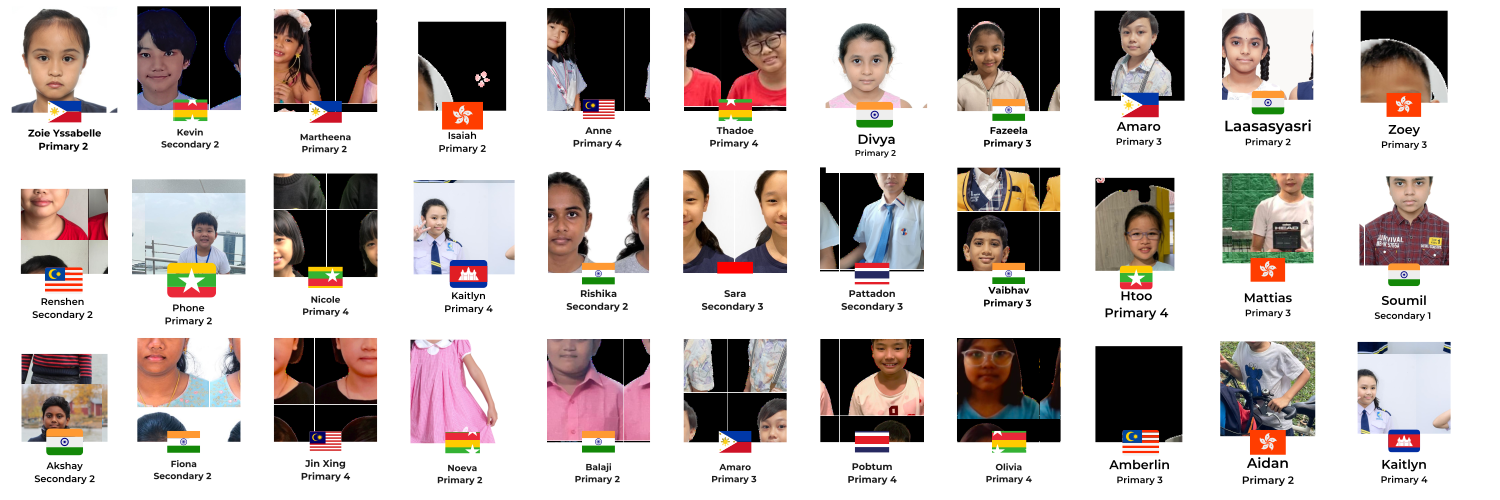
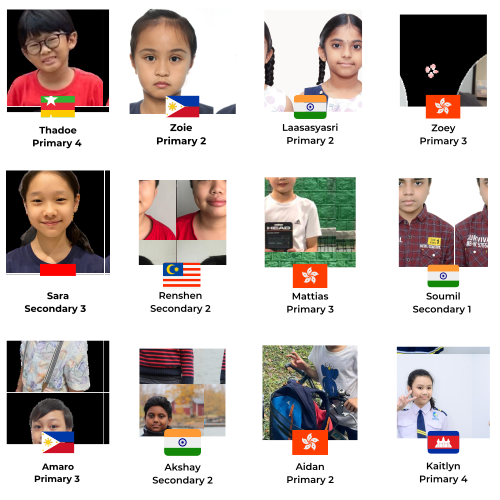
For more than 12 years, we have supported students and families through the AEIS journey, from understanding the admission process to preparing for the examination. With thousands of students guided towards their Singapore education goals, our team brings practical experience and a student-focused approach to every stage of preparation.
Your child’s journey to studying in Singapore starts with the right preparation. Let our experienced team help make each step clearer, more focused and achievable.

Understanding AEIS in Singapore
The AEIS admission process is designed to place international students into appropriate school levels based on academic readiness and curriculum alignment.
What Does AEIS Mean?
The Admissions Exercise for International Students (AEIS) is a centralised examination conducted by Singapore’s Ministry of Education (MOE). Its main purpose is to evaluate whether an international student can adapt to the national curriculum used in Singapore’s mainstream schools.
The AEIS exam tests two core areas:
- English Language Proficiency: Assessing vocabulary, grammar, comprehension, and written expression.
- Mathematics Skills: Evaluating numeracy, logical reasoning, and problem-solving according to Singapore’s rigorous standards.
These tests reflect the actual expectations of local schools, ensuring that successful candidates are academically ready to integrate into the Singapore education system.
Expert AEIS Guidance Backed by Qualified Teachers
Preparing for the AEIS exam can be challenging for international students, but AEIS.com.sg makes the journey smoother and more effective. Parents trust us because of our strong track record in helping students excel in Singapore’s competitive education system:
Years of AEIS Preparation Experience
Guided by MOE-trained teachers with over a decade of experience in helping international students qualify for Singapore schools and excel in their exams.
Students Successfully Prepared
Lessons tailored to achieve the required AEIS scores and gain admission to local schools.
Exam Success Rate
Proven results from structured lessons and personalised feedback that build understanding, confidence, and long-term academic skills.
Purpose of the Admission Framework
The AEIS admission framework is designed to ensure international students are academically ready to integrate into Singapore’s structured education system. It focuses on fair placement, curriculum alignment, and long-term academic suitability rather than short-term performance.
Focus on Curriculum Compatibility
Placement decisions are based on how well a student’s prior learning aligns with Singapore’s MOE syllabus. This ensures students can follow classroom instruction effectively and cope with subject expectations after admission.
Standardised Academic Benchmarks
Consistent academic benchmarks are applied across all applicants, regardless of educational background. This standardisation ensures fairness and maintains the academic integrity of Singapore government schools.
Emphasis on Academic Readiness
Students are assessed on their ability to understand concepts, apply knowledge, and think logically. The framework prioritises analytical thinking and application-based learning over rote memorisation.
Integration into Government Schools
Successful students are placed into mainstream classrooms alongside local peers. This supports academic continuity and encourages smoother social and educational integration within the school environment.
Why AEIS Matters for International Students
For parents, the AEIS represents an opportunity to secure a place for their child in one of Singapore’s highly regarded government schools. Passing the AEIS allows a student to join either primary or secondary levels, depending on their age and performance.
Students who perform well will be placed in a school according to the respective admission exercise timeline:
1) AEIS: Placement begins in January of the following academic year.
2) S-AEIS: Placement typically takes place in Term 3 of the same academic year, or around April/May after the release of results.
Factors Considered for School Placement:
- Availability of school vacancies
- Proximity to the family’s Singapore residence
- Student’s test results and level suitability
While parents may indicate preferences, the final decision rests with the MOE, and transfers are generally not permitted after a school has been assigned. This process ensures fairness and efficient distribution of placements across schools.

Academic Challenges International Students Preparing for AEIS
Many capable students require structured support when transitioning into Singapore’s academic environment. Differences in curriculum, teaching style, and classroom expectations can create initial learning and adjustment challenges.
Differences in Teaching Methodologies
Singapore classrooms emphasise structured reasoning, clear working steps, and outcome-focused learning. Students coming from other systems may need time to adapt to this disciplined and methodical approach.
Curriculum Gaps
International syllabi may not fully align with Singapore’s MOE curriculum standards. These gaps can affect a student’s ability to follow lessons confidently during AEIS preparation without targeted academic support.
Academic Language Adaptation
Students must become familiar with subject-specific terminology and the precise language used in academic questions. Understanding how questions are framed is essential for accurate and effective responses.
Time Management Expectations
Lessons and assessments are paced efficiently, requiring students to plan their work and respond within set timeframes. Developing effective time management skills is critical for consistent academic performance.
Examination Technique & Answer Structuring
Singapore assessments emphasise clear working steps, logical structure, and accurate answer formats. Learning proper exam techniques helps students present responses effectively and improve scoring consistency during AEIS preparation.
Emotional Adjustment
Adapting to a new education system can initially impact a student’s confidence and motivation. Supportive guidance helps students build resilience and adjust positively to new academic expectations.

Eligibility for AEIS
The AEIS is open to non-Singapore Citizens and non-Permanent Residents aged between 7 and 17 years old. Applicants can seek admission to the following levels:
- Primary 2
- Primary 3
- Primary 4
- Primary 5
- Secondary 1
- Secondary 2
- Secondary 3
Each level’s test is designed to match the learning outcomes of Singaporean students in the same age group. Therefore, it is important for parents to assess their child’s academic readiness before applying.
When to Register and How the Process Works
The AEIS and Supplementary AEIS (S-AEIS) are conducted twice a year to provide international students with opportunities to enter Singapore government schools. Early AEIS registration is strongly recommended due to high demand and limited availability.
AEIS is typically held in February/March and is open for the following levels:
S-AEIS is usually conducted in September/October and is available for:
- Primary 2
- Primary 3
- Primary 4
- Primary 5
- Secondary 1
- Secondary 2
- Secondary 3
- Primary 2
- Primary 3
- Primary 4
- Secondary 1
- Secondary 2
Primary 5 and Secondary 3 are not offered under S-AEIS, as these are critical preparation years. Primary 5 students prepare for the PSLE, while Secondary 3 students prepare for the O-Level examinations.
Registration opens prior to each examination cycle and places are subject to availability. Parents are advised to monitor official announcements and apply within the stipulated registration period.
After submitting the online application, parents are required to:
- Upload the necessary identification and academic documents.
- Complete payment within the specified timeframe.
- For Primary 2 to 5 candidates, ensure the child sits for the A2 Key or B1 Preliminary examination and meets the required standard within 12 months of registration.
Students who do not succeed on their first attempt may retake the AEIS or S-AEIS, or consider enrolling into private MOE schools that align with the same Singapore MOE’s education standards.
What Happens If Your Child Does Not Pass AEIS
Failing the AEIS does not close the door to education opportunities in Singapore. Parents can explore two common paths:
Reattempting the AEIS Exam
Students who do not pass the test can reattempt it in future examinations, provided they continue to meet the age requirements for the respective level. This gives them the opportunity to improve weaker areas before the next attempt.
Learn How Our Students Attend an MOE Private Primary/Secondary School While Preparing for AEIS:
Many students enrol in an MOE-aligned private primary or secondary school that follows the exact curriculum of Singapore government schools.
While studying, they concurrently prepare for the AEIS exam for their intended entry level. If a student does not pass the AEIS exam, they continue in the private school and are promoted to the next academic level without losing valuable time. The following year, they can reapply for the AEIS examination at the next level, fully prepared and confident.
At AEIS.sg, we guide parents in planning this journey strategically, ensuring every child maximises learning, gains exam experience, and has the best chance of success.
Hear From Our Happy Parents
AEIS.sg: Genuine Support and Guidance for Parents Navigating AEIS
Preparing for AEIS can be challenging, especially for families new to Singapore’s education system. AEIS.sg provides continuous guidance, from registration support to exam readiness assessments, helping parents manage each step with confidence.
We also assist with:
- Understanding school placement and admission procedures
- Choosing the appropriate entry level for each child
- Providing regular academic progress updates
- Support with applying for the Student Pass and Long-Term Visit Pass (LTVP) for mothers accompanying their child
- Assistance to apply for vaccination and complete vaccination verification with Singapore authorities (HPB)
- Arranging trusted Singapore host families for parents who choose not to accompany their child
With AEIS.sg, parents receive reliable academic and administrative support, ensuring a smooth and well-planned study journey in Singapore.
Secure Your Child’s AEIS Success with AEIS.sg Today!
Give your child the opportunity to succeed in one of the world’s most respected education systems. Whether it’s their first AEIS attempt or a retake, AEIS.sg provides the guidance, resources, and support they need to excel. Let’s make your child’s dream of studying in a Singapore Government School a reality.
Need Clarity?
Not sure where to start or which AEIS level your child should start with?
Frequently Asked Questions
What is AEIS, and who is it meant for?
AEIS is an admission pathway created by Singapore’s Ministry of Education for international students seeking entry into government schools. It is designed to assess whether students can adapt academically to Singapore’s national curriculum.
Which students are eligible to apply for AEIS?
AEIS is open to non-Singapore Citizens and non-Permanent Residents, typically between the ages of 7 and 17. Eligibility depends on the student’s age and the level they are applying for.
Which school levels can international students apply to?
International students may apply for selected primary and secondary levels, subject to availability. Each level aligns with the expected learning outcomes of local students in the same age group.
How does school placement work after passing AEIS?
School placement is determined by the Ministry of Education based on test performance, availability of vacancies, and proximity to the family’s registered Singapore address. Parental can only indicate preferred residential area – not preferred schools.
Can parents choose the school their child will be placed in?
Parents may indicate preferred schools during the application process. However, final placement decisions are made solely by the Ministry of Education to ensure fairness and balanced distribution across schools.
What subjects are assessed under AEIS?
Students are assessed on English Language and Mathematics, focusing on comprehension, application of concepts, and problem-solving ability aligned with Singapore’s academic standards.
How often does AEIS registration take place?
Registration usually opens twice a year: AEIS and S-AEIS. Due to high demand, parents are encouraged to monitor official timelines closely and complete applications early.
What happens if a student is not successful on their first attempt?
Students may apply for the next available AEIS or S-AEIS intake, depending on eligibility (AEIS: P2–P4, S1–S3; S-AEIS: P2–P4, S1–S2).
Alternatively, parents may enrol their child in an MOE-aligned private school that follows the Singapore government school curriculum, allowing the student to progress academically while preparing for the next admission opportunity without losing time.
Is prior knowledge of the Singapore curriculum required?
While prior exposure is not mandatory, familiarity with Singapore’s learning style and syllabus expectations significantly improves a student’s ability to adapt and perform confidently.
How long does it take to receive placement results?
Placement outcomes are usually released a few months after the assessment period. Successful students typically begin school in January of the following academic year for AEIS. Or after the mid-year term break for S-AEIS. (This is subject to when the student receives a student pass)
Can students apply for AEIS while living outside Singapore?
Yes, international students may apply from overseas. However, they must be able to travel to Singapore to complete the required assessment procedures when scheduled.
How can parents better prepare their child for AEIS?
Parents should focus on strengthening English proficiency, mathematical reasoning, and familiarity with Singapore-style academic expectations. Structured preparation and early planning play a key role in success.